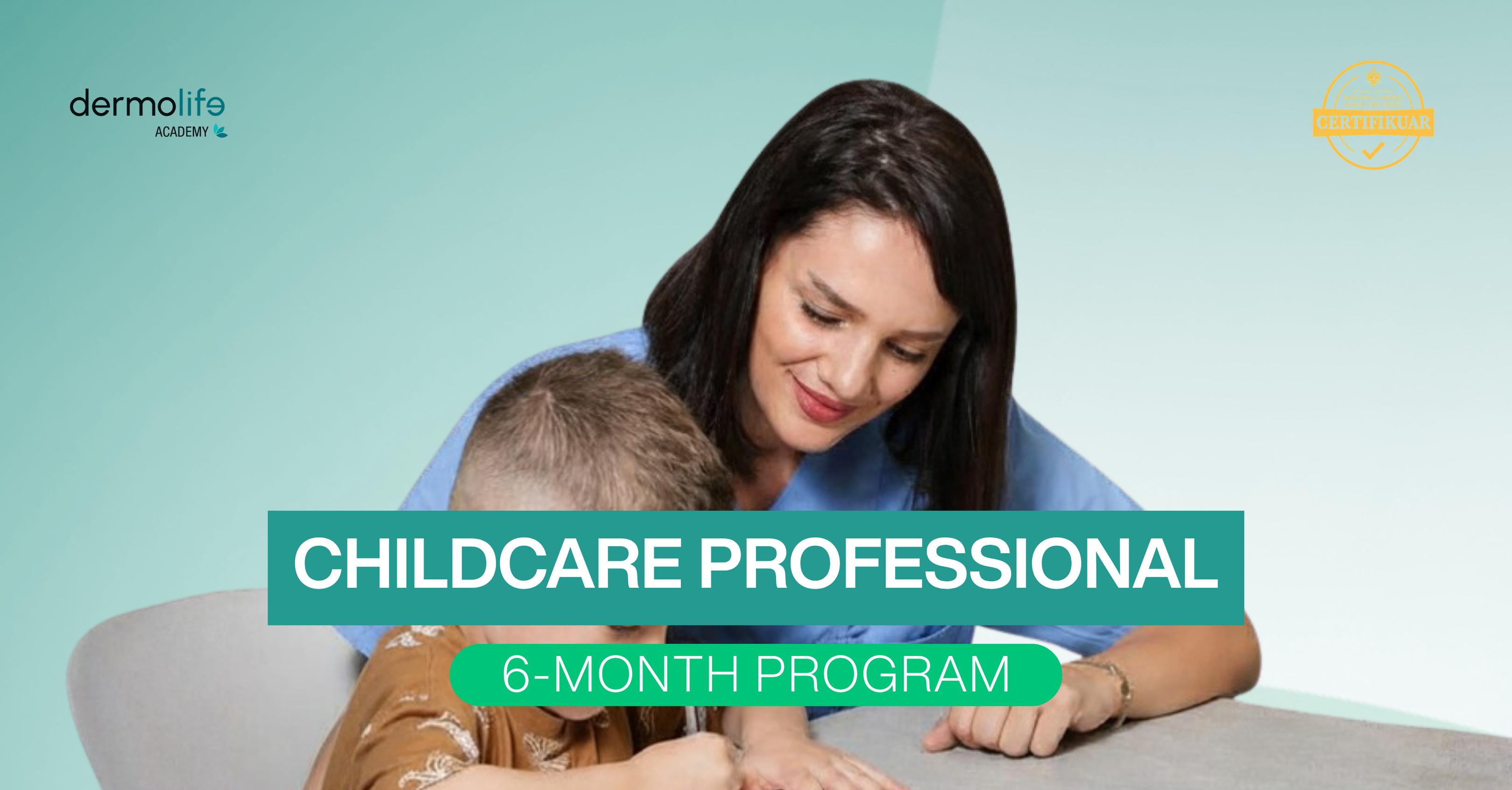
6-Month "Child Care" Program
Participants must be over 18 and have completed upper-secondary education. The program
prepares child caregivers for employed or self-employed work by developing essential knowledge,
professional procedures, and practical care skills.
The success of the babysitter is closely related to behaviors such as: empathy, responsibility, resourcefulness, care, concentration, not using alcoholic beverages, accuracy, correctness and discipline, behaviors that help him meet the demands and cope with the difficulties of the job. The profession is closely related to work procedures for meeting the child's basic needs, organizing educational and socio-entertaining activities, taking care of the child's health and ensuring a safe environment, strictly implementing child protection policies.
He/she can be employed as a babysitter in a nursery, in a family, in the school and preschool system, etc. With work experience and additional qualifications can progress to the level of qualified childminder. Through further qualification in vocational schools or on-the-job training, one can take on supervisory functions, rising to manager of child care centers. Attending high school leads to the graduation of specialists in this profession. In order to develop private activity and for self-employment, registration is required to exercise activity as a natural or legal person, as the case may be. This course prepares trainees with professional competences to exercise activities included in the unit "Child care workers" (code 5311), referred to the National List of Professions.
What does the program cover?
This study program includes the following modules:
- Introduction to the childcare profession
- Implementation of child protection policies
- Taking care of the child for his orientation in time, space and rhythm
- Caring for social development and communication in children
- Taking care of children's basic needs
- Giving first aid and caring for a sick child
- Ethics and building professional relationships with children/families
- Fundamentals of care and inclusion for children with disabilities
Assessment and certification
- Communicate with professional ethics with children, parents/legal guardians, colleagues
- They apply the rules at work and use the right tools in the work environment
- Implement child protection policies
- Exercise the child for orientation in time, space and rhythm
- They take care of the child's behavior and attitudes towards others
- Exercise the child in speech development and verbal/non-verbal communication
- They assess the child's general condition, perform physical care and feeding
- Respect the rules of personal and environmental hygiene
- They assess the emergency as appropriate, provide first aid and document it
- They measure the temperature, breathing and pulse, and take care of the sick child
- They assist technically during the medical visit and examinations
- They take care of children with various disorders in the body
- Communicate with the child's parent or legal guardian and build professional relationships
- Refer cases to other services as needed
- Identify the specific physical, cognitive, social, and emotional needs of children with disabilities
The trainees are evaluated by the instructors for all the learning outcomes that include the course modules and, after the positive evaluation, enter the final theoretical-practical exam. If they are evaluated positively even in the final exam, they get the corresponding certificate recognized by MEKI.
Work & Salary
Childcare Specialist / Nanny
The Childcare Specialist / Nanny program prepares professionals to provide responsible and professional care and support for children in family and educational environments. Graduates can work with private families, nurseries, kindergartens, educational centers, and children's activity centers. Earnings can range from approximately 80,000–120,000+ ALL per month, depending on experience, qualifications, responsibilities, and workplace. The profession also offers opportunities for stable employment and private arrangements with families.
Earning Potential
In terms of maximum earning potential, the vocational programs at Dermolife Academy offer diverse career opportunities across several growing industries. Business Manager has the highest potential, with earnings reaching 200,000+ ALL per month, followed by Web Designer, Nutrition Specialist, Graphic Designer, and Elderly Caregiver, with potential earnings of up to approximately 150,000+ ALL per month. Advanced Aesthetics and Childcare Specialist / Nanny can reach approximately 120,000+ ALL per month.
Important: For Web Design, Graphic Design, and Advanced Aesthetics, earnings can exceed these figures when professionals work as freelancers, build a strong private client base, offer specialized services, or establish their own business.
Study Programs
.webp)
3-Month Program
Advanced Aesthetics
.webp)
6-Month Program
Advanced Aesthetics
.webp)
1-Year Program
Advanced Aesthetics
.webp)
2-Year Program
Advanced Aesthetics
.webp)
1-Year Program
Wellness and Sports Nutrition Specialist
.webp)
Elderly Caregiver
6-Month Program
.webp)
Child Caregiver
6-Month Program
.webp)
Business Management
6-Month Program
.webp)
Graphic Design
6-Month Program
.webp)
Web
Design
6-Month Program

Python Programming
1-Year Program

Data Science
1-Year Program
Computer Networking Specialist
1-Year Program