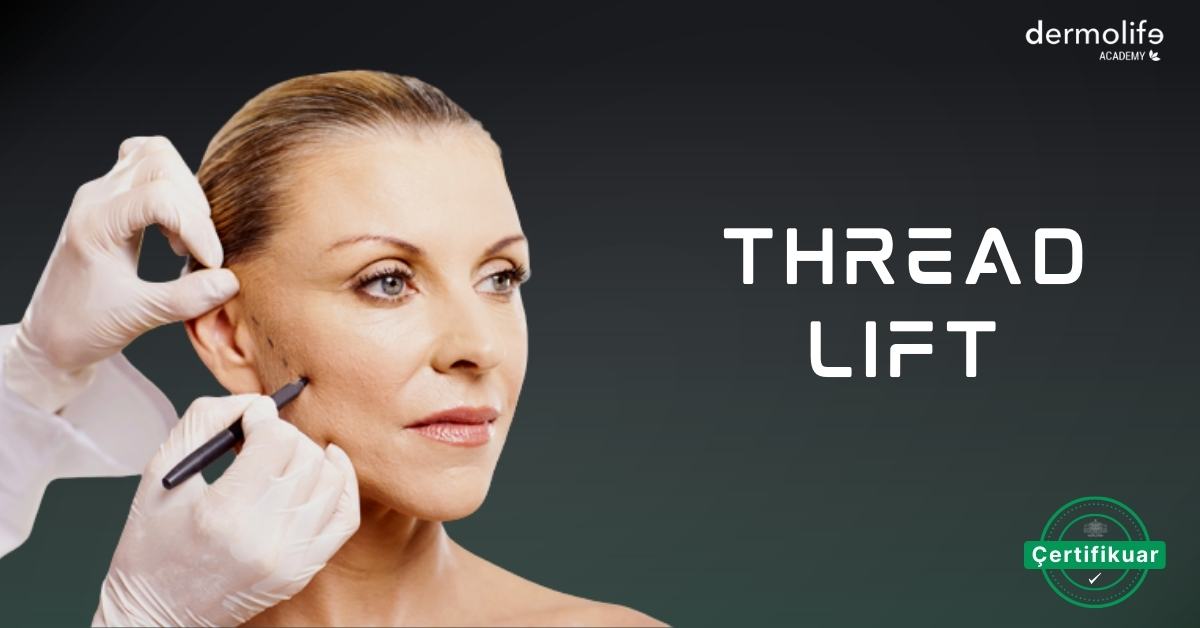
About Thread Lifting
Thread lifting is a minimally invasive aesthetic technique designed to lift and support areas of facial skin without conventional surgery. Depending on the treatment plan, practitioners may use absorbable threads made from materials such as PDO or polycaprolactone. This individual course covers patient assessment, treatment planning, application techniques, expected results and aftercare.
How is the procedure carried out?
- The practitioner begins with a detailed facial assessment, identifying areas where the skin has lost firmness or elasticity.
- A treatment plan defines the target areas and the direction in which the threads will be placed.
- The number and type of threads are selected according to the patient's anatomy, treatment goals and the area being treated.
Expected duration and recovery:
- Results and their duration vary according to the thread material, treatment area and individual patient factors.
- Absorbable threads dissolve gradually, while collagen remodelling may continue after they have dissolved.
- The procedure may require local anaesthesia, depending on the technique and treatment plan.
- Recovery time varies, and patients should follow the treating professional's aftercare guidance.
Can thread lifting be combined with other treatments?
Where clinically appropriate, a qualified practitioner may include thread lifting in a broader treatment plan alongside procedures such as botulinum toxin or hyaluronic acid fillers.
Indications:
- Treatment of wrinkles
- Improving the appearance of skin laxity in the neck and jawline
- Supporting facial contours
- Use within an appropriately planned combination-treatment approach
Who are the ideal patients?
- Suitability depends on the patient's health, skin condition, degree of laxity and treatment goals—not age alone.
- A thorough consultation is required to identify contraindications, set realistic expectations and determine whether the procedure is appropriate.
Side effects:
- Temporary swelling, bruising, tenderness or skin irregularity may occur after treatment.
- Recovery and the time needed for results to settle vary between patients.
- The training addresses risk awareness, contraindications and appropriate post-procedure care.
This training will take place in two parts:
1. The theoretical part:
-
The following topics will be covered in the theoretical part:
- How is the thread lifting procedure performed?
- What are the expected effects and side effects?
- How long does its action last for the elimination of wrinkles?
- At what age can it be used?
- Can it be combined with other treatments?
- Is the procedure safe?
2. The practical part
During the practical component, the trainee observes and practises the thread-lift workflow under supervision, with attention to case-specific assessment, application techniques and post-procedure care.
By the end of this training, the trainee will be able to:
- Explain thread lifting and the indications for its use
- Describe the principles of different application techniques
- Assess expected outcomes and provide appropriate aftercare guidance
- Compare the benefits and limitations of thread lifting with other treatment options
- Plan a suitable post-procedure routine for the patient
Study Programs
.webp)
3-Month Program
Advanced Aesthetics
.webp)
6-Month Program
Advanced Aesthetics
.webp)
1-Year Program
Advanced Aesthetics
.webp)
2-Year Program
Advanced Aesthetics
.webp)
1-Year Program
Wellness and Sports Nutrition Specialist
.webp)
Elderly Caregiver
6-Month Program
.webp)
Child Caregiver
6-Month Program
.webp)
Business Management
6-Month Program
.webp)
Graphic Design
6-Month Program
.webp)
Web
Design
6-Month Program

Python Programming
1-Year Program

Data Science
1-Year Program
Computer Networking Specialist
1-Year Program