
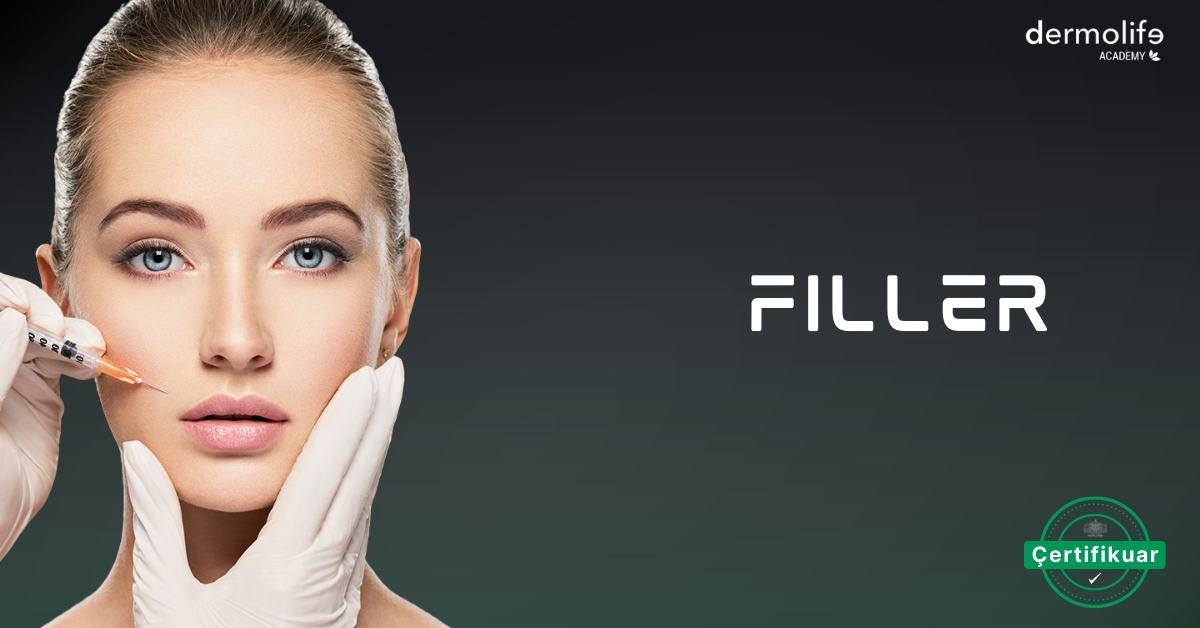
General information about what fillers are:
A dermal filler is an injectable substance used to add volume or create an aesthetic effect that continues after the treatment session. Several types of fillers are available, including products based on hyaluronic acid or collagen. Hyaluronic acid is among the best-known and most widely used materials.
- Hyaluronic acid is naturally present in the body and is widely used in temporary dermal fillers.
- Its effects commonly last for several months, after which the material is gradually absorbed by the body.
- Dermal fillers may soften signs of facial ageing or enhance selected facial features.
- There is no specific age to start treatment with hyaluronic acid.
- For younger adults, treatment often focuses on enhancing features such as the lips or cheekbones; for older adults, it may focus on restoring volume.
This training will take place in two parts:
1. The theoretical part:
-
How are fillers classified?
- If we talk according to duration, we have 3 types of fillers:
- Temporary fillers;
- Semi-permanent fillers;
- Permanent fillers;
Fillers are classified by duration, composition, and intended treatment volume.
-
What are temporary fillers?
- A filler that is naturally absorbed after its aesthetic effect ends is considered temporary.
- Temporary fillers may include products based on collagen, fat, or hyaluronic acid.
- In this aspect, there are many discussions. Absorption and duration also depend on a lot other factors, so the classification is debatable. (Some authors consider it fat as a semi-temporary filler, some others also consider their own forms special hyaluronic acid as not totally temporary.)
-
What are semi-temporary fillers?
- A semi-temporal filler is considered a filler which, even after the completion of aesthetic effect, stays for a while in the body.
- For example, even a few years after the aesthetic effect of the filler has ended, in radiology it is distinguished as a homogeneous area (specific for the radiological presentation of bones), that is, as bone life
- These fillers, in fact, in terms of aesthetics, do not last much longer than fillers temporal. The duration of their effect is 6-18 months (although in general acid standard hyaluronic acid remains 3-12 months in the skin, then it is absorbed; 40% of its effect aesthetic, if the injection is done by a specialist and the care is proper from patient, the duration is 2-3 years).
-
What are permanent fillers?
- Surely everyone has heard about silicone.
- It has an excellent effect, especially on the lips, but it is one of the substances that has the most effects unpredictable.
- Some of the side effects expected from injectable silicone are: granuloma, necrosis, swelling, embolism and, as a result, blindness, cerebral pulmonary infarction, etc.
-
Expected effects of fillers:
- Softening facial wrinkles and folds, such as nasolabial folds
- Internal support of wrinkles (eg wrinkles at the corners of the lips)
- Enlargement of the upper or lower lip
- Cheekbone or chin augmentation
- Filling of cheeks or other areas that present atrophy
- Facial lifting with hyaluronic acid (liquid facelift)
- Correction of furrows under the eyelids (tear trough)
- Personalized treatments.
-
Application techniques:
- The face is divided into sections and each area is analysed separately to identify treatment needs.
- Based on some signs of the face, we draw the lines of orientation, which will help us enable a complete analysis and detection of possible facial asymmetries.
- Next, by following these lines, the appropriate filler is injected into the places that need reinforcement.
- Treatment aims to soften wrinkles, support areas affected by volume loss, and enhance selected facial features.
- In order to minimize the pain of injections, a special anesthetic cream is used , which is applied before each session.
- In areas such as the cheeks, neck and eyes, so-called "skin boosters" are used, i.e. hyaluronic acid injections with triple action.
- First, they improve skin hydration and increase its elasticity.
- Second, the reduction of relaxation (liquid face lift) is achieved at a later time the production of endogenous collagen and stem cells is stimulated, giving the skin that face an even more youthful look. In the case of lips and mouth, we can adapt treatment in order to achieve the desired result. We can correct the angle lips, to reduce the pronounced wrinkles of the upper lip, to tone the contour of lips or to reduce the thin vertical lines of the lips.
-
What should we keep in mind after treatment:
- Immediately after the therapy, a light massage is performed with a special cream, which calms it down even more the face and reduces possible edema.
- There are usually no symptoms left after treatment and most patients recover immediately work and daily activities.
- Depending on the treatment applied, it may take 2-5 days for the filler to accumulate the amount enough water and take its final form.
- After the treatment there is no pain and complications are very rare.
- During some procedures other protocols are applied and the injections are done gradually with quarterly intervals, in order to obtain an ideal duration of the result.
- Treatment results last about 10-14 months:
- However, in areas such as the lips, as a result of mobility and natural activity hyaluronidase enzyme, their action is usually shorter, about 6-8 months.
- The application of fillers is done in certain quantities and in such a way as not to deform the features of the face. The results are always natural.
2. The practical part
In the practical part, the trainee will get to know the different types of fillers, as well as practice their application on the face and other parts of the body where it is applied, depending on problematic or within the framework of the desired aesthetic result.
By the end of this training, the trainee will be able to:
- What are fillers and indications for their use
- There are several types of applied fillers, which have their own specifics
- There are several techniques for applying fillers
- What effects do we expect to have, as well as the post procedure care
- The benefits of applying fillers compared to other similar procedures
- What routine is recommended for the post-procedure patient?
Study Programs
.webp)
3-Month Program
Advanced Aesthetics
.webp)
6-Month Program
Advanced Aesthetics
.webp)
1-Year Program
Advanced Aesthetics
.webp)
2-Year Program
Advanced Aesthetics
.webp)
1-Year Program
Wellness and Sports Nutrition Specialist
.webp)
Elderly Caregiver
6-Month Program
.webp)
Child Caregiver
6-Month Program
.webp)
Business Management
6-Month Program
.webp)
Graphic Design
6-Month Program
.webp)
Web
Design
6-Month Program

Python Programming
1-Year Program

Data Science
1-Year Program

Computer Networking Specialist
1-Year Program